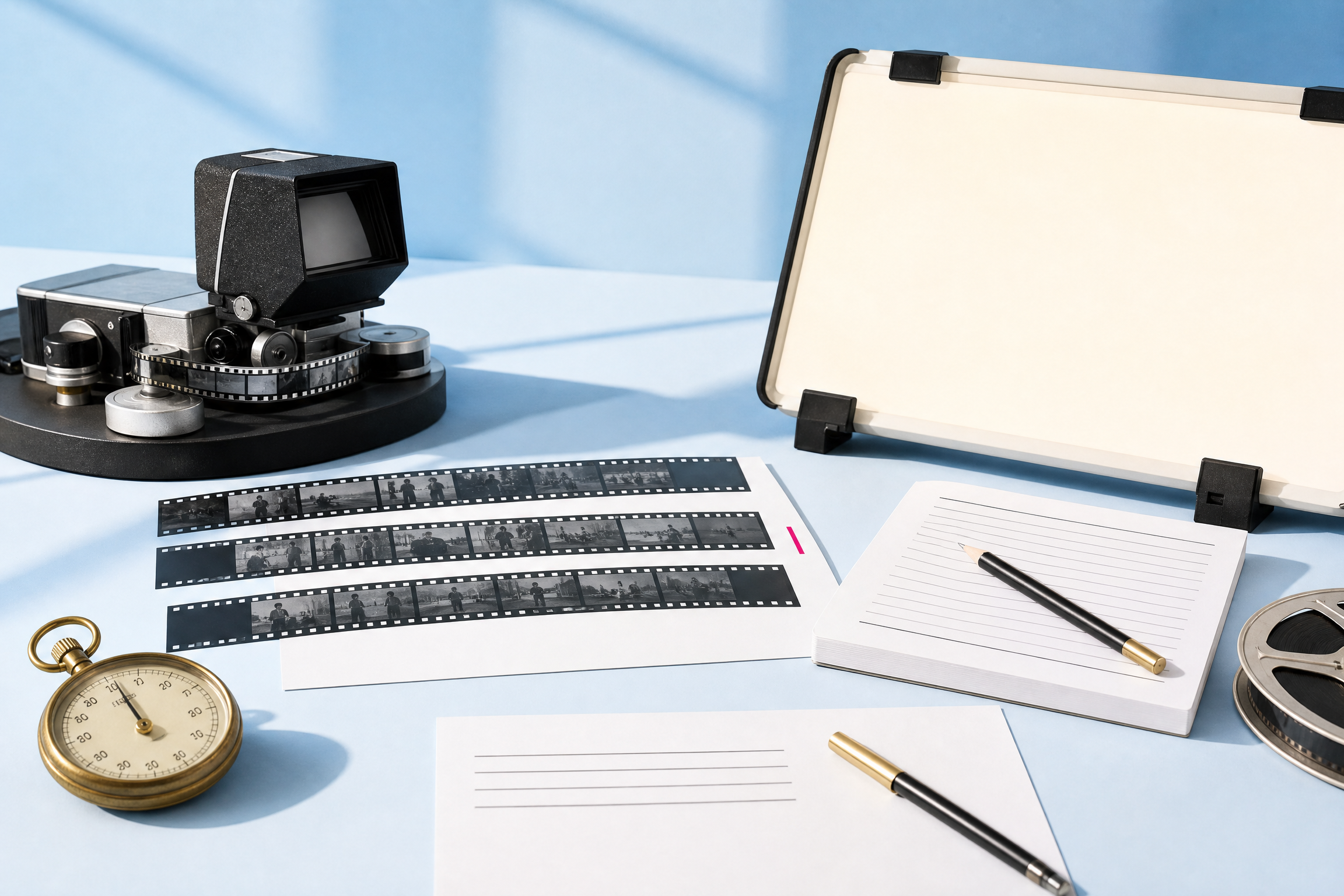
Choose clips where you can be seen and heard clearly, your performance is the focus, the scene reaches your work quickly, the full set shows useful contrast, and the footage still represents your current look and ability.
Reel-editing framework
This RoseCo editing framework shows how picture, sound, actor focus, pacing, and contrast can be reviewed before an edit. It is not client footage or a claimed result.
Start with picture and sound you can use
A strong performance is difficult to appreciate when the viewer cannot hear the dialogue or see your face. Review every clip for clear sound, usable picture quality, and a frame that keeps your performance visible.
Some color and image problems can be improved in editing. Damaged or buried audio is often harder to rescue. Be honest about what the footage can support before building the reel around it.
References: [1]
Make sure you are the focus
A recognizable co-star or beautiful scene does not help if the clip mainly showcases someone else. The viewer should understand who they are meant to watch and what you are doing in the scene.
Give enough context for the moment to make sense, then get to your performance. Long entrances, establishing shots, and another actor’s setup can often be shortened.
Choose contrast, not repetition
Five versions of the same emotional note can make a longer reel feel smaller. Look for useful contrast in tone, pace, relationship, or genre—without forcing a clip into the reel only to prove range.
The goal is not to show every possible character. It is to choose a set of moments that makes your work feel specific and alive.
Use footage that represents you now
Recent footage usually gives the clearest picture of your current look and skill. Older material can still help when the performance is strong and the project remains relevant, but it should not create confusion about who will walk into the room today.
Do not chase one universal length
There is no single runtime that fits every actor, every type of reel, and every set of available footage. Use only the material that earns its place. Make the opening useful, keep each scene moving, and remove repeated information.
- Can the viewer see and hear you clearly?
- Are you the focus of the clip?
- Does the edit reach your performance quickly?
- Does this clip add something the others do not?
- Does the footage represent your current look and ability?
- Do you have permission to use the footage?
References: [1]
Named client work appears only with permission.
RoseCo does not present invented actors, fictional sites, or unapproved material as client results. Educational frameworks explain the work; approved client examples appear only after delivery and permission.
Let the strongest moments do the work.
Gather the strongest usable clips first. Then build a plan around what the footage actually proves. A clear reel is not the one with the most material. It is the one that makes every included moment easy to understand.
Send footage for a quote